
Table of Contents
What are the CSBG Organizational Standards?
The CSBG Organizational Standards are a comprehensive set of standards developed with input from the entire CSBG Network through a three-year multi phase process led by the Center of Excellence. The Organizational Standards were announced in January 2015 with the OCS release of IM 138, State Establishment of Organizational Standards for CSBG Eligible Entities, directing States to establish organizational standards by fiscal year 2016.
The Organizational Standards are organized in three thematic groups comprising nine categories and totals of 58 standards for private, nonprofit entities and 50 for public entities. The purpose of the organizational standards is to ensure that all agencies have appropriate organizational capacity, in both critical financial and administrative areas, as well as areas of unique importance to the mission of the Community Action network.
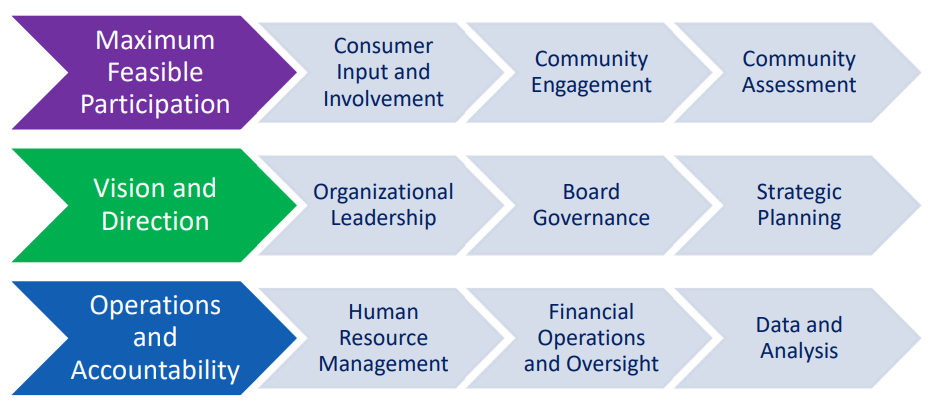
In 2012, the National Community Action Partnership launched the Organizational Standards Center of Excellence, with support from the Office of Community Service, at the Department of Health and Human Services as a part of a broader effort to enhance the accountability and organizational performance of CSBG funded programs. Toward this end, the Organizational Standards Center of Excellence spearheaded the network-wide effort to develop high-quality performance standards with the mission of ensuring all Community Action Agencies have the capacity to provide high-quality services to low-income individuals and communities.
Since the establishment of the Organizational Standards in 2016, the Center of Excellence continued to collaborate with network partners through 2019 to provide ongoing training and technical assistance that supports the implementation of the Standards across the network.
In summary, the CSBG Organizational Standards represent important minimum thresholds to ensure Community Action agencies have the needed capacity to serve the United States’ communities. The full implementation of the principles and practices articulated in the Organizational Standards assures a consistent and strong CSBG network.

The Community Needs Assessment is the focus of the CSBG Organizational Standards’ Category 3: Community Assessment, though there are a few other Standards that refer to a community assessment as well.
Below are the standards directly related to the community assessment process: