
Table of Contents
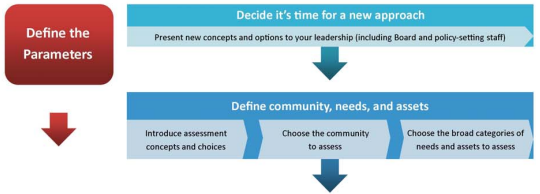
The CAA Community Needs Assessment should contain all the factual and opinion-based input leaders will need to complete the next strategic planning process. That plan will rely on its findings as it offers a focus on local conditions, analyzing the economic opportunities and barriers for all residents who are at risk of remaining or becoming economically insecure, as well as identifies existing and potential resources to expand opportunities. This means your CNA will require a high level of effort to complete a comprehensive community assessment that contains all the information your agency will need to prepare a new multi-year strategic plan.
Therefore, the assessment process must engage all key CAA stakeholders, including the Board and management staff, as they will be the primary users of the information and analysis. They must commit to the scope and issues addressed in the comprehensive needs assessment and should be recruited to represent the agency and to recruit participation during the information-gathering and reporting phases.
Begin by explaining the need to expand the strategic planning process to include more information, such as assessments of community assets and challenges and agency options and priorities. Then explain the rationale for an inclusive approach to assessing needs in order to plan effectively. Finally, explain how the assessment can measure more than just individual, family, and social service needs.
Introduce assessment concepts and choices
The start to the planning process is discussing and agreeing on the scope, content, and cost of the comprehensive assessment. Once a budget is decided and before determining the information needed to gather, the CAA must clearly define how the information will be used and who the audience will be. Ask yourself, “How will the CAA use the CNA in future strategic planning? Will the CNA be used to create other kinds of public reports to further the agency’s identity and role in the community?” Your answers will help give your CNA’s content direction and begin forming a framework for its design.
Choose the community to assess
As the designated anti-poverty agency in a given geographic area, each local CAA must be able to describe the entire area broadly. This means that the community assessment must provide information on the entire service area. The service area is the “geographic area identified in an approved grant application within which a grantee may provide CSBG services. A program must propose a service area in the grant application and define the area by county or sub-county.” Maps submitted as part of the community assessment document should show the entire service area.
However, CAA leadership also should identify where they plan to target their assessment and to articulate why that target was selected. Ensure that leaders consider boundaries that include essential resources, supporters, individuals and families affected by CAA activities.
It is important to note that the subject of the assessment is the community’s needs. It does not refer to the needs of individuals in poverty nor to specific kinds of needs. While CAAs have wide discretion in choosing the priorities for their Community Action Plan, they are directed to base that plan on a complete analysis of the community-wide conditions in order to address verified and urgent local needs.
Choose the broad categories or needs and assets to assess
The leadership’s role is to set the general parameters of the assessment and to approve a process that will bring them a final design to review. You need to consider categories of issues to be studied and decide which indicators will best capture the community’s strengths, assets, needs, and weaknesses.
A comprehensive CNA will require thinking about such indicators in a more comprehensive framework by connecting the closely related causes of poverty and collecting various forms of data. It cannot be achieved by a survey of CAA customers’ satisfaction with the services they now receive, by asking customers what services they need, or by only updating economic and social data that are part of the CAA statistical profile. These approaches only assess a narrow “market,” not a whole “community.”
This way of thinking should result in agreement on the broader questions which will define the categories of issues to assess. Be sure that the CAA’s leadership agrees that “assets” – local resources and positive trends – will be included in the research along with needs and problems to provide strategic planners with realistic information about options. Common CAA groups of related issues, or domains, include: CSBG Service Categories, ROMA Goals, and Agency-Designed Categories.
.
.
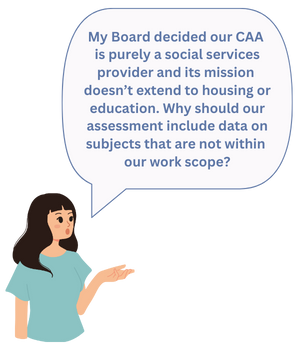
The CAA is not weak if the mission is based on a thorough, recent assessment of all the unmet needs of residents of the low-income community served and the resources already available. If it is determined through a strategic process that the primary unmet need is for social services, then the agency should feel confident that it is meeting community needs in the best way possible.
However, if there hasn’t been a recent, truly comprehensive community assessment then it is probably time to carry out a full inquiry about conditions that threaten economic security. The CAA will want to find out what trends and resources are available to make those conditions better, and to strategize on partnerships to ensure an integrated effort is underway with multiple organizations coordinating their efforts.
Be sure the Board knows that a CAA is expected and empowered to be the antipoverty expert in the community and to use that expertise, part of which comes from strong assessments, to coordinate all the other community resources to most effectively address economic security.