
Table of Contents
The View From Here: Empowering and entrusting community action agencies to stabilize families and communities during COVID-19

Kris Schoenow, CCAP
Executive Director
Bureau of Community Action and Economic Opportunity
Michigan Department of Health and Human Services
Even before the novel coronavirus began to impact residents of Michigan, a great deal was known about its ability to spread quickly and to leave a trail of chaos and death in its wake. Especially, we knew a pandemic as far-reaching and unrelenting as COVID was creating urgent human needs, and the state of Michigan had to be ready to mount an equally urgent and ambitious response.
The Bureau of Community Action and Economic Opportunity (BCAEO) set up emergency communications and began adapting to the emerging environment: sudden high unemployment, shortages of food and other essentials, the need for many to quarantine after possible exposure to COVID, fast-spreading sickness, and families suffering the unbearable heartache of saying goodbye to loved ones they were not permitted to be with.
Our priority was to stabilize communities and provide essential services to residents through community action. And we knew we had to move fast to prevent delays, gaps and disruption of care.
One of our first tasks was to do a critical review of services to determine how we would continue operating, given that in most cases we could no longer work face-to-face with colleagues or clients. Most staff would be working from home, and both clients and staff would have to convert to technology-based communication. That, alone, was a substantial challenge. Community action agencies have felt they can do their best work when they meet one-on-one with individuals and families. That close communication helps agency staff establish trusting relationships with clients, which is key to helping clients become socially and economically mobile. But literally overnight, and with no model to follow, computers and phones had to take the place of handshakes and working side-by-side.
Most community action agencies quickly tapped into technology solutions so they could continue to connect with residents. But internet service is not available in all communities across the state, and the cost of access prevents many from subscribing even where it is available. Agencies had to develop ways to work with residents who had no access to computers or even to telephones.
Food, housing, water, and utility payments quickly soared to the top of the list of critical needs facing Michigan residents. Before COVID, most communities struggled with a shortage of affordable housing. The pandemic complicated and increased that problem and also created the need for specialized temporary housing for adults and children exposed to the virus or already sick. They needed a place where they could stay for a time and not have to connect in person with the world outside their door. Several agencies asked for help from community partners who owned hotels and motels. With traveling at a standstill, many had vacancies and offered their unused rooms for individuals and families who had no other appropriate place to go.
Agencies also looked for ways to help residents pay their water bills so they could continue to maintain hand washing, which became critical to slowing the spread of the virus.
From the beginning, the highly contagious nature of the virus challenged and changed our methods of delivering services. For example, clients had usually been invited to come into food pantries to choose the foods they needed, but that was no longer possible. Instead, some agencies had clients drive into a parking lot and open the trunk of their car or a back seat door so they could receive a box of prepared meals or groceries. Others had clients call on their cell phone when they arrived, and were asked by staff to, “open your trunk and we’ll bring out the food.”
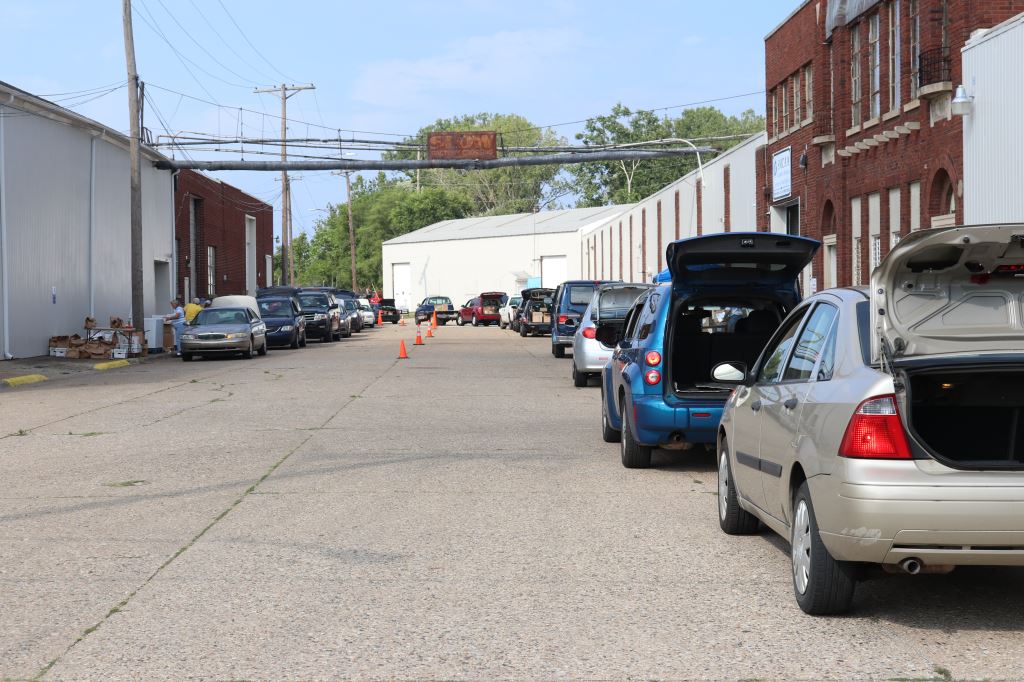
For those who could not leave the security of their home, or were afraid to, delivery of meals to their doors began in earnest, often with the assistance of Meals on Wheels drivers.
The work of our essential COVID Response Teams
The Bureau of Community Action and Economic Opportunity (BCAEO) began evaluating ways to best use Community Service Block Grant (CSBG) funding for COVID-related programs for residents. We established five regional COVID Response Teams across the state, each with representatives from five or six community action agencies. The teams met virtually during the week to learn what was happening across the state. We shared vital information such as the movement of the virus, the emerging needs and vulnerabilities of communities, and the capacity of agencies to meet needs.
Food pantries quickly experienced the same limited availability of food and supplies as grocery stories, so we began monitoring a food work group to be sure our distribution chains remained intact.
Because the increase in the need for food was sudden and huge, the bureau submitted a grant request to Consumers Energy Foundation and received $500,000 to build food storage and distribution capacity in several key communities. The funds proved valuable for short-term needs such as the purchase of thousands of boxes used for packaging food that would go directly to clients’ homes or into their cars. One agency used some of the funds to purchase a much-needed forklift for its warehouse that is a distribution point for more than one million pounds of food each year.
Agencies reported they were losing volunteers who wanted to stay home to minimize their exposure to the virus, so the BCAEO worked with the state’s emergency manager to put in place a volunteer pipeline. A hot line was also set up so agencies could request support from the Michigan National Guard.

A new dashboard helps balance supply and demand
As the need for food grew, so did fear among households who desperately needed it. People often lined up hours before a distribution opened, and sometimes agencies ran out of food. To better manage state- and region-wide supplies, the Bureau created a food distribution dashboard that made it possible for us to simply click on each county to see the status of its food inventory. The dashboard provided schedules for food distributions and locations, quantities of food that community action agencies had on hand and other key information including spikes in food and meal distribution.
Once information about supply and demand began funneling into the dashboard, we had a valuable big picture of the state so we could plan and respond to food needs. One successful strategy involved constantly moving goods from agencies with an excess to those with a shortage. To the best of our ability, we wanted to be sure food was available to those who needed it, and the dashboard helped make that possible.
The dashboard also gave us the opportunity to learn from each agency’s experience as the virus moved from county to county. Early on, it seemed Upper Peninsula residents might be largely spared, but sadly, we watched the virus move steadily north and eventually cross the Mackinac Bridge.
The lifesaving CARES Act
The federal government moved quickly to pass the CARES Act, distributing money to states as Community Service Block Grants. Michigan received $36 million. Because of our regular regional meetings, we already had a sense of how that money could be best spent. By looking at each agency’s budget, we determined how to distribute it across the state so the funding would have greatest impact for residents. Priorities included helping with rent or mortgage payments, covering utility bills, repairing rural residential water systems, distributing food, and expanding technology for residents who did not have internet access.
Despite the huge and immediate need for food, it was only 8% of our budget because the Department of Education funded a substantial percentage of food program costs.
We also identified special needs created by COVID. For example, inmates were being released early to reduce the spread of the virus in jails and prisons, and community action agencies were able to help them with housing, food, and other basic needs.
Because we documented needs, we were able to advocate for receiving $50 million from the Coronavirus Relief Fund, the stimulation program that followed the CARES Act. Monitoring use of that funding was critical so we could be sure it was focused specifically for people impacted by the virus.
As the months dragged on…
Fear was high, especially in the hard-hit southeast Michigan counties. Gathering advice from public health officials, community action agencies began promoting the best ways to stay safe. By late spring, utility shutoffs began, threatening disastrous results for thousands of families. The problem was compounded because it came at a time when schools and businesses were largely closed and we were all asked to stay in our homes except when taking care of essential tasks such as grocery shopping or picking up medications.
Migrant workers coming into the state had little opportunity and few resources to protect themselves and others from the spread of the virus. Many also lacked updated information about it. Missing a growing season could mean financial catastrophe for workers, so some, after testing positive for COVID, moved on to different farms in order to continue working. The result was that the virus began spreading through the workers and beyond.
Then, when the COVID chaos seemed like it could not get any worse, the Lower Peninsula was hit by record rainfall, destroying dams and flooding communities.
Technology connects us
While community action agencies were dealing with urgent on-the-ground needs, departments within the State of Michigan were implementing innovative technology to help assist residents and bridge gaps of support.
Coordination with 211 was expanded. Building on the 50-year success of the 911 emergency line, 211 is a call line that provides information about the availability of essential services. When residents call with questions about how to help, or ask where to go for assistance, they are given the names of organizations and resources to contact.
Every department and community action agency within the state began an earnest review of policies to determine how to modify them in order to fully function amid the limitations brought on by COVID. For example, activities requiring face-to-face contact were suspended or modified and often replaced by technology such as ZOOM and other platforms that can safely and instantly connect people. From client counseling to providing information about food programs or medical care, agencies learned to deal with the barriers of disrupted electronic communication and limited access to WIFI. Policies that required signatures were relaxed, permitting signatures to be gathered whenever a face-to-face meeting could occur. Some agencies developed a single standard client signature form that covers all services the client wants to apply for and can be signed by the client electronically.
Most important, we encouraged community action agencies to evaluate all the options available to them and to use the methods of communication and verification that worked best for them and their clients.
Widening the eligibility range, sustaining communities
When the federal government allowed us to provide federal funds to families with incomes of up to 200% of the poverty level, thousands of residents who had lost jobs or were indefinitely laid off became eligible for urgently needed assistance. Prior to COVID, when we evaluated a family’s eligibility, we usually looked at the previous three months of income. But because so many were suddenly and without notice unemployed, we changed our policy and looked at only the previous 30 days of income. Our goal was to keep households stable so they would not need continued help once jobs returned.
The change in eligibility helped sustain tens of thousands of families through the pandemic. Had we not made that change, families that had been successfully getting by prior to COVID and were suddenly hit by tragedy such as the loss of a job, the hospitalization of a family member with COVID, or the death of the household’s primary income provider would likely have plunged into poverty and been stuck there for a long time.
Community Assessment Reports tell the story
The CARES Act requires state governments to complete a statewide community needs assessment and community action agencies to do the same for their region. That information will give us a detailed look at the demographics, needs and resources in communities across the state and will help us plan and define our roles and responses for everything from minor localized emergencies to wide-spread catastrophic events.
This report will help you understand how the state’s network of community action agencies impacts the quality of life for Michigan residents, especially those with low incomes. It will show you how we, as a state, were able to mobilize quickly to provide information and life-changing assistance from the earliest days of the pandemic. It will also demonstrate how providing immediate and significant emergency support to stabilize Michigan residents through months of COVID is preventing long-term financial disaster for families who lost their economic foothold because of the virus.
To community partners reading this, thank you for your enormous role is supporting Michigan residents. You stepped in swiftly and generously and have been extraordinarily creative in helping solve problems of all sizes.
The ongoing ravages of COVID
The number of residents testing positive with the virus spiked again in fall of 2021 and into the early months of 2022. Reluctance by many to be vaccinated, or to vaccinate their children, continues as well. Still, Community Action is moving ahead, seeking solutions to situations that prevent people from achieving social and economic mobility. For example, in many communities, we have begun looking at office buildings vacated by tenants during the pandemic and envisioning how those empty spaces might be converted to much-needed permanent housing such as apartments with reasonable rents.
For more than 60 years, community action agencies have focused on eliminating poverty, building communities that are strong and healthy, and helping individuals and families become socially and economically mobile. Agency staff members are skilled at incubating new programs. They are flexible, creative, and tireless in advocating for the well-being of adults and children in this state.
Each community action agency must adhere to a set of standardized rules and regulations, and they are encouraged to apply them in ways that best respond to the needs and resources in their communities. They have feet on the street. They know the issues their residents face, and they partner with the organizations that can help resolve them. Working with impassioned volunteer boards of director, they stretch and manage state and federal funding, corporate grants and private gifts. They are trusted by their clients and their business partners. Their word is good.
The data and stories in this report offer a picture of the children and adults across this state whose lives were forever changed by both a ruthless pandemic and the safety net that is Community Action.