
Table of Contents
.

.
Assess the capacity of the agency to:
- Enter information and use public databases for the consolidated community profile and analysis.
- Analyze the various types of data that will be collected for the assessment including surveys, census, client databases, and government data.
If it is determined that the CAA doesn’t have the capacity for these tasks due to lack of knowledge, time, or other resources, are there other organizations to partner with? The State CSBG office? Academic institutions? Faith-based and other nonprofit organizations?
If so, bring them into the planning process at this stage because who will do the analysis may determine how the data are collected.
Decide what data is needed and how to get it
Databases and reports
Use databases from multiple years for agency and customer profiles to identify trends for the agency. National Performance Indicators (NPI) information and the CSBG Information Survey (IS) client data are unparalleled sources for client data. The demographics for family and individual indicators collected from other sources for this assessment should match the information in the CAA’s customer database and CSBG IS submission. The analysis will then compare the CAA participants’ information to the same data points of the wider population to help determine what share and sub-sections of the local population is being served.
Surveys
Surveys should not be your only source of data for a comprehensive CNA. In general, agency community surveys can be costly and may even be ineffective for seeking information related to complex problems.
Wording and topics are critical elements in survey design. The best way to develop a useful survey is to engage staff in meetings to discuss the questions that will be asked. CAA staff has expertise in analyzing the needs, especially the unmet needs, of the population served and other significant populations.
Consider who should be surveyed but remember that a very large group of answers is not necessary to ensure the results are statistically significant. Though it does reveal if a cross-section of opinions from many different groups was captured. A community-wide survey can measure awareness of the CAA, its reputation, and its potential as a recipient of funds from the private sector. It may also be useful to employ a longer survey to a specific target group, such as a survey on the household economic conditions for a group of economically vulnerable residents.
Similarly, customers are a terrific resource for reporting on the realities of life in the low-income community, including community assets and how those improve their situation. However, the CNA must engage many community residents other than customers and ask many different questions about agency assets. If the CAA leadership feels customer satisfaction questions must be included, consider designing them as the baseline for the separate customer tracking that the CAA will establish in the future.
Meetings
Meetings have two very important functions when they are part of the assessment:
- Providing data on needs, assets and opinions, and;
- Informing the public about the CAA’s process for leading community-wide considerations of economic and social issues.
The process also demonstrates the degree of the CAA’s commitment to obtaining and using content from public participation. Remember, the act of soliciting opinions and listening actively is also an important outreach activity for the agency.
- Focus groups – Focus groups are tools to produce information on specific topics that can be combined with other results, including other focus group reports. Focus groups must follow a formal process in which open-ended conversation is structured into quantifiable and comparable output.
- Community forums – It is important to know who is in the audience at a large community discussion, so the input received can be interpreted. Large public discussions can be very helpful, but are not necessarily representative of a community and may not be able to provide an in-depth understanding of all of the issues. Sometimes a very vocal minority can dominate a community forum, and while this provides important input, it may not be helpful in assessing the opinions of the community at large. Other times, the only people who attend the meeting are those who have a vested interest in what is to be discussed.
- Interviews – Ideal candidates for personal interviews are local leaders, Board members, or new groups and potential partners. Design interviews that are structured conversations with open-ended questions that highlight, explore, and/or solicit your interviewee’s interests and resources.
.
.
Organize the data
Make final choices about the content and length of surveys, focus groups, and community listening sessions. The number and length of staff discussion groups and partners’ leadership interviews can be flexible elements of the plan. Decide on the number of indicators to collect from databases and interviews and the general topics of meetings and interviews. This process of defining and limiting data collection is also a determining factor in which questions will be assessed in the final report.
.
Engage the Board to confirm plan
The assessment team must re-engage the Board so they may review the scope and nature of the data collection plan and its cost. In this way, the Board agrees to own the specific content and approach of the assessment now that a clear plan and format are available.
.
Develop the messages to community and partners
The leadership must directly decide on the CAA’s public communication about the assessment process, choice of surveys and meetings, and the potential uses of the outreach and exposure generated by the process and results.
.
.
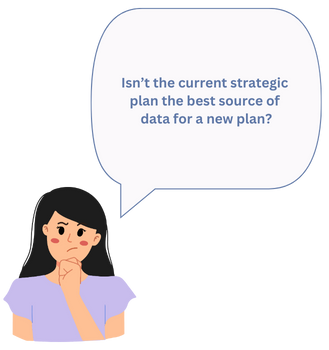
Using indicators related to strategies in the current plan is one way for an agency to learn how effective the strategic approach was and remains at present. However, a new assessment may be necessary to provide information that allows the leadership to consider new approaches.