
Table of Contents
.
.
At this point in the process, the CAA leaders have helped define the focus and scope of the assessment activities. There is an unduplicated wish list of data items and their sources. The CAA knows whether they can be easily accessed, or if resources will need to be devoted to securing them.
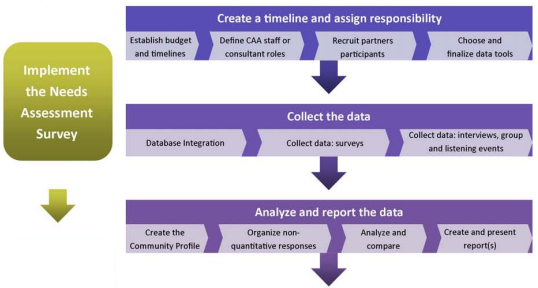
1. Create a Timeline and Assign Responsibility
Establish a budget
The budget will depend in part on the choices to make in implementing the information collection process.
- How will surveys be distributed to the general community? How much staff time, mailing costs, and advertising will be needed?
- How many focus groups and interviews will be conducted? Will facilitators need to be hired or public meeting space and audio/visual equipment need to be rented?
- How much volunteer or paid staff time is available from key participants, and how is it distributed over time?
Many CAAs report they have cut costs by using AmeriCorps staff and Summer Youth Program participants for many tasks. Consider the interests and talents that the skilled CAA volunteers could provide.
Develop an implementation timeline
The length of time it takes to gather information for the community assessment and then to write the report will vary depending on the size and complexity of the CAA, the community at large, and the service area. The community assessment timeline must include enough time for a report to be written. In addition, because the community assessment provides the evidence and rationale for a variety of programming decisions, the process must be timed to enable the findings to be used to inform the strategic planning process. For example, proposed changes to program options that are presented in the next strategic plan must be guided by information previously gathered and analyzed in the community assessment report.
Choose and finalize data tools
The assessment team should now prioritize the questions and identify key partners and sources of information. Many data items will pertain to multiple issues; they can be sorted at this point using lists organized by the source. Try organizing data sources as published statistics, survey information, focus groups or interviews, and community forum responses.
.
2. Collect the Data
Refer back to the decisions you made in Step 3 on what data you need for the CNA and methods to use (databases and reports, surveys, meetings) for how to get it.
Manage the data systemically
Your community assessment data comes from many places and in a variety of forms. Before starting the data collection process, it is important to approach the issue of data management systemically by addressing the following questions:
- How will you keep track of all the data?
- How will you make the data available to key members of your team?
- How will you ensure certain data is kept confidential?
- How will you collect and integrate data over a period of time?
- How can you set up the system so others can step in if your job responsibilities change?
- Do you want to use a graphic information system (GIS) to link gathered data to the respondent’s location?
Assuring participants’ confidentiality is an essential part of gathering written or verbal information. Let all participants know that the process is confidential; individual names will not be included in the community assessment report; findings are reported for groups, not individuals; and that participation is optional. State this protocol about confidentiality up front and repeatedly. Ideally, this understanding can be extended to external stakeholders, who may also be more willing to participate if there is meaningful discussion around the importance of protecting the privacy of shared clients.
It is likely most data, especially quantitative data, will be stored on a computer. Keep in mind that the data management system needs to be understood by key members of the team, particularly if they will be involved in analyzing the data and making contributions to the community assessment report.
Plan for cultural considerations
As you plan to conduct the community assessment, make sure to understand and observe the social customs and practices of families whose cultural and linguistic backgrounds differ from your own. Some populations may be cautious about engaging with you, particularly if they don’t know why you are approaching them. In these situations, seek out trusted individuals who can introduce you rather than simply showing up and introducing yourself.
Collecting data related to community resources and strengths can be particularly challenging. The best advice is to build strong relationships with community agencies and maintain ongoing contact with them. Then, when it is time for the community assessment, they are more likely to participate in the process and provide useful information. In fact, representatives from community organizations might be willing to serve on your team.
There are a number of strategies that might help you collect information about community resources. Send a brief questionnaire to a large number of agencies. The strategy is to use a short questionnaire that is not time-consuming and to reach many agencies because a low response rate is likely. You can include a stamped, self-addressed envelope as an incentive to respond. You can follow up with phone calls or interviews when an agency does return the questionnaire.
Combine and integrate similar data
Statistics, survey responses, and meeting information should all be organized according to the specific indicator they are assessing and each indicator should be categorized according to the issue domain(s) to which it contributes information.
.
3. Analyze and Report the Data
Even before you have collected all your data, you can begin interpreting the emerging trends. This will enable you to make adjustments immediately when problems with data quality or gaps in data sets are identified early on. In analyzing the data, ask your team to look deeper than simply tabulating results:
- What do the findings mean about trends and changes in your community?
- What patterns are occurring?
- What possible actions should be taken by your program based on what you have learned?
Data analysis is conducted through a series of different procedures designed to reveal what the data has to “say.” It is the process of combining, comparing, and finding patterns in data to highlight useful information, answer specific questions, and inform decision-making.
As you begin to develop your data analysis plan, you will need to make decisions about what kinds of analytic procedures to use and how to present the findings. Although the process may seem overwhelming at times, data analysis is a logical sequence of steps.
.
After you have collected and analyzed all relevant information, you will be able to use the data for goal-setting and decision-making. Use the community assessment findings to prioritize key issues; determine the unmet needs for Community Action services among eligible low-income residents; identify vulnerable populations; and locate priority service areas.
The final Assessment Report must communicate the agency’s judgments about what the data and opinions mean and focus on choices for the next strategic plan. Pages of data collected should not be presented without being processed. Data are just numbers, not useful information, until they are analyzed.
Interpret and organize all the data
When the team designed the issue domains, they created a framework or structure; now the information must be put into the categories of the framework. It is the CAA’s unique analysis that will add meaning to the numbers and opinions. Data from interviews and surveys may also belong in the community profile.
Consider all the information from the agency – collected surveys, interviews, and group discussions. Ask:
- What does it show about issues that are foremost in the mind of residents and leaders?
- What needs to be changed in, or added to, the original issues framework?
Trend data gathered through the community assessment can be particularly valuable in helping you frame and prioritize recommendations. Your report needs to refer to trends when they are relevant. Census and PIR data spanning a timeframe can also point to demographic and family changes. Estimates of eligible populations are another source of trend data and can help you forecast future program services.
Organize all the findings into the issues framework selected, and analyze the results related to needs, assets, and suggested solutions. The results should not include CAA plans for action.
Some CAAs feel they should put every piece of information into the body of the assessment report even if it wasn’t significant enough for them to analyze. This is unnecessary! Thoughtfully analyze and share your collected data within the context of the larger framework.
Caution: If a survey or group meeting result feels “wrong” to experts in the CAA after objective debate, it may not reflect reality. Remember that the survey responses are from a small population, and even a truly random sampling can turn up a non-representative group. Also, the questions may have been understood differently by the respondents than intended by the experts. Plan to do more research to validate results before implementing major changes in CAA strategies, especially if reliable staff disputes the information collected.
Create a Community Profile
Statistics from general data sources, including the profile of local economic trends and conditions and information about community assets, will be combined into a profile of the community. This profile is merely a description until the report highlights important connections revealed through the assessment process.
Refining the descriptive output is essential to giving focus and meaning to the information. Pick key findings to emphasize. Focusing on clusters of important related information is important to the analysis. Analyzing the conditions that are described adds meaning which is important to help the CAA’s leaders, partners, and community accept and utilize the assessment.
Establish goals and measurable objectives
Community assessment findings related to immediate family, agency, and community needs will be used by the Community Action agency to develop program goals and objectives. Keep in mind that program goals are broad statements that move the CAA forward in its mission and demonstrate the agency’s commitment to continuous quality improvement and the establishment of strong management, fiscal, and service delivery systems.
Strategic service goals are paired with objectives, which also identify resources needed to carry out the objectives. When its objectives are Specific, Measurable, Attainable, Realistic, and Timely (SMART), the CAA can effectively assess its progress toward achieving planned changes within the specified timeline.
Develop the assessment into a report
The community assessment is primarily intended to inform CAA strategic investment decisions. It should be written to stand alone, ready for the CAA’s leadership to act on the information it contains. The CAA should describe conditions, deficits, and assets that may be of interest to various partners or stakeholders, but the final report should answer readers’ questions as they read about the identified needs, they may be thinking, so what? Or, what next? The needs assessment report should not be a final source of recommendations to the community.
You will need to prioritize your decisions and recommendations based on the community assessment data. Provide your rationale for prioritizing one recommendation over another. Some reasons you might give include:
- The service can be implemented more easily.
- The service addresses a greater need.
- The service responds to a trend that, in the next few years, will impact the agency.
- By partnering now, community resources may be maximized and offer improved service delivery to those in need.
Different, separate reports should be generated for the public, for key leadership and for partners and communities of interest. The data are certainly rich, and every CAA is responsible for making the public aware of poverty conditions and economic insecurity and of the resources available to address the problems.
The assessment can appropriately conclude with an explanation of how the CAA will proceed to create its long-term annual strategic plan which will, of course, be based on the Community Needs Assessment, the consumer satisfaction analysis, and an analysis of indicators regarding national, state, and local performance goals.
.