
Table of Contents
The Role of Community Partners
“The fabric of Northeast Michigan Community Service Agency has been our relationship with community partners. We had good relations before, and we’re leaning on them even more. They are part of who we are. That’s why our middle name is community.”
Lisa Bolen, Northeast Michigan Community Service Agency

“Our list of partnerships is long,” says Michelle LaJoie, Community Action Alger Marquette. “It is how we are able to do so much for so little, how we address gaps, reduce duplication of services and can provide clients with a large menu of resources. We can’t do it alone. It is a community effort. We might get the grant, but the work is often shared by several agencies.”
“We didn’t realize how well everything was turning out until we stood back and looked,” she adds of the community-wide response to the pandemic. “We are getting rid of the silos and the fact that everyone was applying for the same pot of money. Now we identify who does what best and that agency runs with it.”
Many community action agencies coordinated with Meals on Wheels whose volunteers delivered everything from meals and groceries to cleaning products. They provided a critical link and a welcome contact for elderly residents who were frequently alone, sometimes afraid, and often dealing with health issues.
“Regionally, we are recognized for our collaborations and have a good reputation,” says Kerry Baughman, Northwest Michigan Community Action Agency, who found that the capacity and commitment of community partners increased during COVID. “For example, we talked about things such as housing shortages and transportation in our region. We formed a food insecurity work group early on that included people who work with pantries and distribution to be sure we were sharing information, identifying gaps, looking for funding and finding ways to solve issues.”
Northwest Michigan Community Action Agency’s senior network became more active, too, getting seniors on a list for vaccines, arranging transportation, and working with other senior-focused agencies.

“We have a very effective human services collaborative body,” says Melinda Johnson, Blue Water Community Action, of the group that includes roughly 70 members representing human services, schools, governmental bodies and others groups, and who share information frequently. The collaborative also has sub-committees that meet and work around specific needs as they arise.
“We’ve had to rely on each other for expertise and for help,” explains Melinda. “For example, one partner is taking over our adult outreach for homelessness. They usually only work with kids, but they took on our program because we have not been able to dedicate staff to it. The Health Department has also been an outstanding partner. When we’ve been concerned or needed advice on procedures, Health Department staff helped us. When they asked us if we could do things like distribute masks, we could help them. We always had a good relationship, but it has been enhanced so much.”
Responding To The Mask Mandate
For roughly 15 months, Michigan upheld a mandate to wear facemasks in public places. The merits of masks were fiercely debated, as were the rights of those who felt the mandate was an overreach of the government. But there was solid evidence that masks helped prevent transmission of the virus. Almost overnight, millions of masks were needed by those who stepped out of their homes to go to grocery stores and pantries, pharmacies and medical appointments, jobs, church, and pretty much any other place. There was an immediate worldwide shortage, and what small quantities could be found online were priced out of the reach of many.
People with sewing machines and a stash of fabric began sewing. Agencies shared the inventory they had, and a lot of recipients of food boxes found masks packed in among their peanut butter and broccoli.
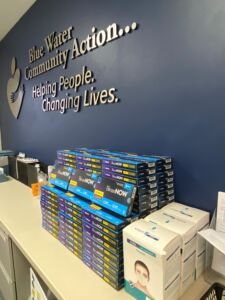
Michelle LaJoie, Community Action Alger Marquette, is grateful for a donation of 20,000 masks her agency received from General Motors early on. “It was such a beautiful gift,” she recalls. “We handed them out to any one and any agency needing them.”
Masks of Marquette volunteers also sewed masks and made it possible for the agency to deliver two masks for each of their 300 Meals on Wheels recipients.
“Every community comes together, so we were not surprised by the generosity in this crisis,” says LaJoie looking back. “Everyone has a little bit, and they were willing to share so no one had to go without. It was truly a feeling of community. Everyone was smiling behind their masks.”