
Table of Contents
How Community Action put millions of bottles of safe drinking water into the hands of Benton Harbor residents
Headlines began to tell a grim and familiar story in October 2021. Tap water flowing into thousands of residences in Benton Harbor contained levels of lead that were greater than acceptable, and residents were told to stop using it. Immediately.
Worse, the story was three years in the making. The city’s water system had exceeded EPA standards for lead contamination since it was tested in 2018, according to the Michigan Department of Environment, Great Lakes and Energy. Six tests conducted six months apart showed each time that at least 10% of the water samples taken from homes and businesses in the city had lead contamination above 15 parts per billion.
Rev. Edward Pinkney, president of the Benton Harbor Community Water Council, plus a coalition of environmental and community organizations filed an emergency petition in early September 2021 asking for an intervention by the Environmental Protection Agency, citing Benton Harbor’s water contamination as a “persistent, widespread, and severe public health crisis rising to the level of substantial endangerment.” They wanted action.
Following the petition, Gov. Gretchen Whitmer signed an executive order to provide residents with bottled water, filters and premixed baby formula. She also pledged to replace the city’s lead pipes over the next 18 months.
That is how Kris Schenow, director of the state’s Bureau for Community Action and Economic Opportunity (BCAEO), found herself headed to Benton Harbor and tasked with creating and coordinating infrastructure for immediate water distribution to thousands of the city’s residents.
“BCAEO and Southwest Michigan Community Action Agency (SMCAA) were asked to help residents without a lot of understanding of what the exact need was,” remembers Kris. But she dropped everything anyway and was there on the ground within hours.
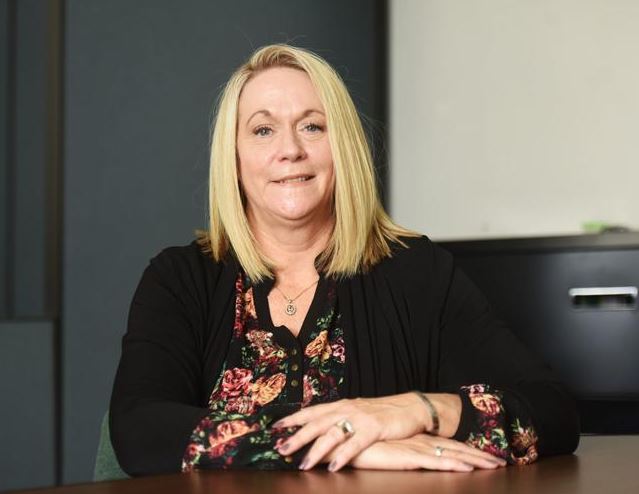
Kim Smith Oldham, Southwest Michigan Community Action Agency
“On September 17, we were told we would be handing out water filters to residents,” remembers Kim Smith Oldham, executive director of SMCAA. That seemed manageable. But on September 21, she got another call. Elizabeth Hertel, director of the Michigan Department of Health and Human Services (MDHHS), asked if SMCAA could distribute water.
It would be a massive undertaking and especially challenging with COVID still hovering. Yet, with its headquarters in Benton Harbor, its detailed knowledge of communities and residents in its region, and support from the Bureau of Community Action and Economic Opportunity, SMCAA was perfectly suited to take it on.
Agency staff held the first distribution of bottled water on September 29. Worried residents lined up around the block in anticipation of getting free water to supplement the water they had been buying since the first warnings were issued.
“In just two hours, we provided water to about 400 households, bigger than our normal distribution of food,” remembers Kim. “We needed more hands on deck.”
Kris Schoenow responded by bringing a diverse crew of workers to Benton Harbor, from fork lift drivers to community planners, who worked closely with SMCAA to understand the needs and resources in the community.
“They helped with logistics and organized partnerships,” recalls Kim. “They developed a data dashboard for water distribution and helped with all the paperwork. Workers from the Michigan Department of Health and Human Services were located at the warehouse for a month to assist with logistics, unloading trucks and delivering water to the extra sites, and they were a great team!”
“They also walked with us through our warehouse and evaluated the equipment and other resources we had to have to be able to distribute the huge volume of bottled water residents would need,” remembers Yvonne Vidt, community services manager for SMCAA. “There were a lot of nuts and bolts that had to be put together, and Kris was the glue that made it happen.”
The community response was gratifying, too. Churches, the United Way, the Boys and Girls Club, foundations and other organizations asked what they could do to help.
“We needed 20 to 25 volunteers, so I reached out to the community through e-mail,” says Yvonne. “We had such a huge response we created new positions such as someone to welcome people as they came to get water and someone to pass out brochures.”
When the program was first launched, cases of water were distributed from four sites, rotating days, evenings, and on Saturdays and Sundays. Churches and other groups offered to distribute water on alternate days.
Home-bound residents were encouraged to call 211 to request water, and drivers with Meals on Wheels and Area Agency on Aging delivered it to them
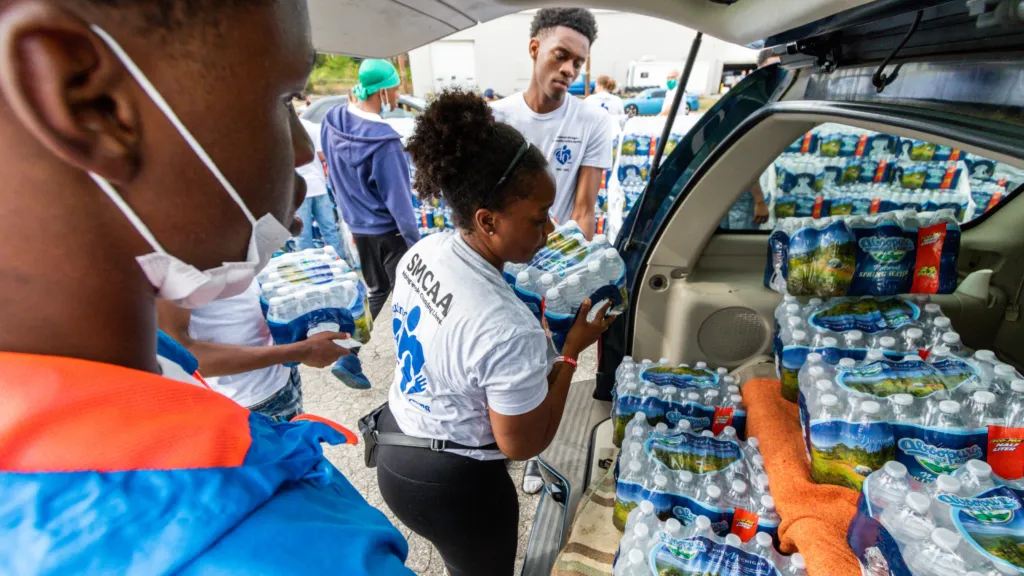
Community volunteers assisting with loading cases of bottled water into residents' vehicles.
“We also distributed bottles of liquid baby formula so families were not using tainted water to mix with powered formula,” says Kris. “We helped bridge the gap until the banking cards, given to families as part of the Supplemental Nutrition Assistance Program, included liquid baby formula as a qualifying purchase.”
“It all went smoothly,” says Yvonne. “We had a good system in place, and the BCAEO was our support team. We gave them ideas. We talked about situations and got their feedback. We bounced ideas back and forth about how we could best get water into peoples’ homes.”
“We wanted staff at SMCAA to know they were not alone,” says Kris, whose department steps in to support local community action agencies during crises until the local agencies can manage relief efforts on their own.
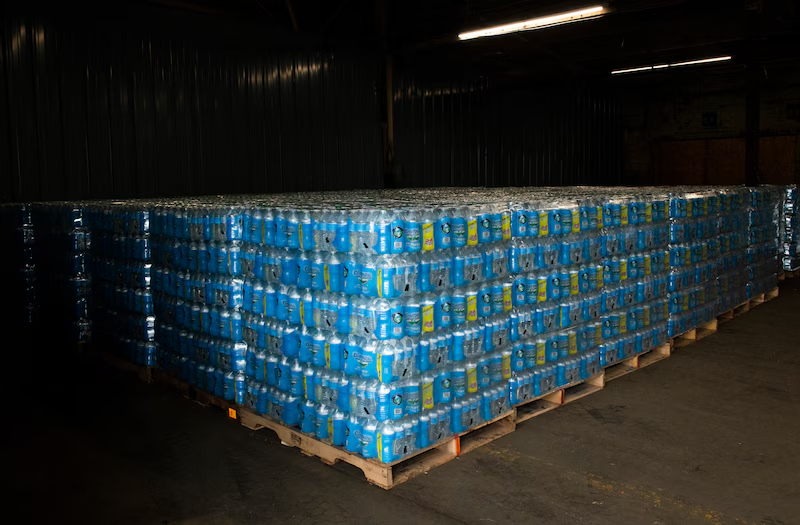
Cases of bottled water stored in the SMCAA warehouse.
“It’s why community action is so successful in dealing with emergencies,” says Kris. “The local agency knows the community, and we know how to move quickly to support them. By partnering with SMCAA, we were able to build extra capacity and train other leads that were needed. When the relief program stabilized and SMCAA could take over operations, we transitioned out.”
Today, there is one central drive-through location where residents can obtain water, plus a self-serve site at SMCAA’s Benton Harbor headquarters. Four churches pick up water at the warehouse and deliver it to residents who are homebound.
“There were so many parts of the rescue operation, and a tremendous working relationship between all parties,” recalls Kris. “We’re grateful to all who participated. So many groups stepped in to help, and there were unexpected gifts of support such as the volunteer forklift drivers who came from out of state. Many people worked several days straight with no break.”
As of the first of May 2023, roughly 594,381 cases of water had been distributed by SMCAA and its community partners. The May 5 dashboard documenting progress to replace lead service lines reported more than 1,700 lines completed with about 2,700 remaining.