
Table of Contents
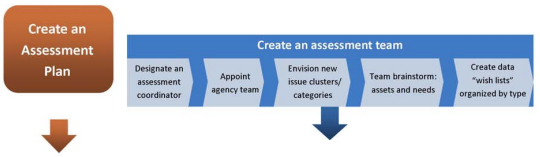
The process of developing the plan for conducting the community assessment is critical. Not only does your plan have to provide a solid foundation for involving key stakeholders from the start, but it will also be your road map throughout the process. A well-articulated plan ensures that your community assessment is thorough, accurate, and efficient. Although it requires an investment of time at the beginning, the community assessment plan will save you time and effort over the long run.
Designate an assessment coordinator
A team approach to conducting the community assessment is beneficial because it distributes the effort among many people and adds a variety of perspectives. The community assessment team plans and implements the process, interprets the data, and presents a report of findings for review by the agency’s governing body.
As soon as the community assessment team is formed, a team leader should be selected. This person will be the primary point of contact throughout the process.
Appoint the assessment team
Appoint a team that will have responsibility for making specific decisions about what data will be needed, who the sources of data will be and how data will be collected. Ideally, the team will include representation from within the program, including those that reflect the diversity of the communities or populations served, as well as external partners. It is helpful to have at least one team member who is skilled at working with numerical (quantitative) data.
Envision new issue clusters/categories
Once your team is appointed, provide it with the decisions about the scope and direction of the assessment determined in Step 1. Begin to envision the broad issues framework for the comprehensive assessment approach. The final plan should answer these essential questions:
- What? Determine the specific information the CAA will collect regarding needs and assets.
- Why? Explain the reasons for choosing to assess information on the selected topics and, conversely, reasons for choosing not to include certain topics.
- Who? Identify the individuals and groups who will be the sources of information. Define the key informants to contact in each “community.”
- How? Acquire the best tools available to gather and quantify that information.
Organize your discussions and choice for information into four broad categories:
- Community profile
- Individual and family needs and assets indicators
- Community organizations’ needs and assets, including the CAA’s
- Community economic and civic data.
Brainstorm on assets and needs
Next, brainstorm about the cause of issues affecting individuals, the agency, and the community. Be sure the team understands that broader, systemic issues must also be considered in order to get a complete picture of all the conditions that can cause poverty, including all of the relevant questions to be asked and data to be collected.
Before moving on to the next step, make sure the data to be collected cover all of the many of contributing factors involved in the issue. Just as the causes of poverty are complex, the indicators the CAA will collect to measure their impact must be multi-layered and comprehensive.
Don’t be satisfied with broad, generalized poverty indicators of the conditions that the CAA is assessing. For example, “transportation” may be the general cause of a poverty-related condition, such as lack of a job but it doesn’t capture the specific issues involved in getting to work. More information is needed to find out exactly what the transportation need is. To address a complex problem, all the contributing factors need to be clearly identified. This will require collecting different kinds of data.
Create data wish lists organized by type
As you identify data sources, ask yourself, “For every issue domain that your assessment is addressing, are data also being collected about the broader, deeper causes of poverty conditions and also about assets and opportunities that might help change the conditions?”
Review the lists for each domain and consider whether changes in recent years can be reported. Plan to ask for updated information for all the standardized data reports from Census, state agency reports, and other third-party sources of demographic and economic data, as they become available. Consider asking survey respondents whether their needs are changing and whether assets or opportunities are different than in the past.
Are there other assessment requirements for the CAA’s programs that mean data should be collected from unique sources, such as Head Start or Continuum of Care programs? Include all required indicators and their sources during this planning phase.